Cohere and Go There
A Solo Exhibition by Gary Stephan
May 14 - July 12, 2025
Wed - Sun, 11am - 6pm
Sun, 12pm - 5pm
Thomas Park is proud to present Cohere and Go There, a solo exhibition by Gary Stephan. In this new collection of works, Stephan continues his exploration of perception and abstraction, focusing on the center of the picture plane and the surrounding planes that interact with it.
The exhibition’s title, Cohere and Go There, reflects this fluidity—a Beckettian wordplay that encapsulates Stephan's exploration of the canvas as both a container and a site of transformation. The center of the picture plane, traditionally viewed as a spatial anchor in painting, is here destabilized. Stephan’s central forms, mostly rectangular, are surrounded by planes that move in and out of alignment, opening and closing like an unfolding structure. These interlocking forms are never fully resolved, inviting the viewer to witness the tension between the static and the shifting, the visible and the concealed.
The play of overlapping and interlocking planes suggests a space that is constantly evolving—a dialogue between what is held and what is released. Stephan’s cerebral approach encourages the viewer to navigate this space, acknowledging the instability of perception as planes dissolve and reconfigure before the eye. As with the act of seeing itself, the works are in perpetual flux, both holding together and letting go.
Cohere and Go There offers a dynamic meditation on the tension inherent in structure and the elusive nature of visual experience. Through his unique manipulation of space in this exhibition, the viewers get to realize that at the center of any coherent form, there is always room for change and redefinition.
Gary Stephan is a New York-based painter known for his innovative approach to abstraction. Stephan began exhibiting in the early 1970s at the David Whitney Gallery and has since participated in major exhibitions including the Whitney Biennial. His work is held in the permanent collections of the Metropolitan Museum of Art, the Museum of Modern Art, the Guggenheim Museum, and the Whitney Museum of American Art. He currently lives and works in New York City and Stone Ridge, NY, and teaches in the MFA Fine Arts program at the School of Visual Arts.
—
토마스팍은 게리 스테판의 첫 번째 개인전 Cohere and Go There를 선보인다. 게리 스테판은 이번 전시에서 추상회화와 그 지각에 대한 지속적인 탐구를 이어가며, 화면의 중심부와 그 주변 평면들이 만들어내는 상호작용에 초점을 맞춘다.
베케트적 언어유희를 연상시키는 전시 제목 Cohere and Go There는 그의 회화에 내재된 역설적인 운동성을 반영하며, 작가가 회화를 형태를 담는 공간이자 동시에 변화의 장소로 사유하는 방식을 함축한다. 미술사적으로 공간의 중심축으로 여겨진 화면의 중심은, 스테판의 작업에서 불안정해진다. 중심에 놓여진 사각형에 가까운 형태는 주변의 색면들과 긴밀하게 맞물리거나 어긋나며, 끊임없이 열리고 닫히는 구조가 된다. 그의 구성은 마치 완성되지 않은 듯, 고정성과 유동성, 보이는 것과 숨겨진 것 사이의 긴장을 형성한다.
겹쳐지고 맞물리는 평면들은 공간이 끊임없이 재편되는 과정을 보여주며, 무엇이 머무르고 무엇이 사라지는지 질문한다. 스테판의 사유적인 접근은 관람자로 하여금 이러한 유동적인 공간을 능동적으로 탐색하게 하고, 지각의 불확실성과 감각의 경계를 자각하게 만든다. 그의 작업은 보는 행위 그 자체처럼, 끊임없이 형태를 바꾸며 응집하고 또 흩어진다.
Cohere and Go There는 구조 안에 잠재된 긴장과 시각적 경험의 붙잡을 수 없는 속성에 대한 명상적 시선을 이끌어낸다. 이번 전시에서 보여지는 스테판의 고유한 형식적 접근을 통해 우리는 ‘일관된’ 존재의 중심에는 언제나 변화와 재정의의 공간, 가능성이 내재함을 깨닫게 된다.
게리 스테판은 뉴욕을 기반으로 활동하는 작가로, 추상 회화에 대한 독창적인 접근으로 잘 알려져 있다. 그는 1970년대 초 뉴욕의 데이비드 휘트니 갤러리에서 전시를 시작하며 주목받기 시작했고, 이후 휘트니 비엔날레 등 주요 전시에 참여해 왔다. 그의 작품은 메트로폴리탄 미술관, 현대미술관(MoMA), 구겐하임 미술관, 휘트니 미술관 등 유수의 기관에 영구 소장되어 있다. 현재 그는 뉴욕시와 스톤리지를 오가며 작업하고 있으며, 뉴욕 스쿨 오브 비주얼 아트(SVA) MFA 순수미술 과정에서 교수로 재직 중이다.
Through The Portal
ㅤ
ㅤ
Preparing Gary Stephan's solo exhibition has been a multi-dimensional experience—one that feels like traveling through time and space. I rediscovered his work on Instagram more than 25 years after our first encounter. He was my first-ever studio visit. At the time, I was working at a gallery near Meat Market, still new to the field, when the owner sent me to pick up a painting from Gary Stephan’s studio. "Choose whatever you like—trust you," he said. That moment, in retrospect, may have marked the beginning of my karma as a gallerist. I selected a piece, put it in a cab, and brought it back. The owner loved it. A few days later, Stephan stopped by the gallery. He stood in front of the painting for a while, then said, "My work usually doesn’t look good in gallery spaces, but this one does."
ㅤ
In December 2024, I flew back to NY to visit Gary Stephan’s studio (I currently live in Seoul and New York). I arrived a few days before the studio visit and had time to go see a show or two. Siena: The Rise of Painting, 1300–1350 was on view at the Met, the one I wanted to see. On my way to the Met, I saw Stephan had posted about one of the paintings from the exhibition on his Instagram: The Temptation of Christ, a panel from Duccio’s Maestà. He had written, "The lower right corner aside in this Duccio 1308 is a portal into the future." A portal. Of course! (Aren’t there infinite portals within the space and time we inhabit?) Stephan must have meant that Duccio’s painting, a sense of depth we feel looking in the "portal" might show the early emergence of perspective. Or did he mean he noticed the shifting of the painting’s gravitational center to the portal, or perhaps he is saying that he is the one who is shifting attention from the iconographic frontality to the surrounding space—something he himself explores these days?
ㅤ
I arrived at his studio without remembering where it was or realizing it was the same space from years ago. He confirmed it hadn’t changed. Standing there, my mind flickered between two images—then and now—moving back and forth in time. Nothing looked quite the same: the space, the paintings, nor even the artist himself. And I, the visitor, had changed as well. Perhaps I had passed through that portal in Duccio’s painting that I saw the previous day, into the future of what I had only briefly imagined when I first selected his work.
ㅤ
Along the beautiful, long wall of his studio, his new paintings were hung. They all shared a similar structure: a central space surrounded by shifting planes, moving between surface and depth, between the visible and what lies behind. He described the center space as empty. In classical perspective, the center of the picture plane is the deepest, the farthest point in space. It made me think of Giacometti—the way he placed the sitter’s head at the center of the canvas so that it receded into the space. His thin figures kind of came out from that deep space. I thought it was interesting Stephan called the space empty. In a picture plane structured by perspective, the moment something is placed deep enough, it literally disappears. That’s why it is called the vanishing point.
ㅤ
His planes appear at times open, at other times closed—acting almost like walls that either enclose the central space or let it remain accessible. As much as they resist, they feel as if we are looking down the interiors of Vilhelm Hammershøi's paintings, as though viewing a floor plan from above, where the rooms are defined by their walls and doors—some ajar, some shut. A solitary woman might be seated or engaged in some quiet task within these quiet spaces, or the rooms are often empty. These paintings, mostly titled Interiors, portray absence as much as presence, inviting contemplation. While both artists construct spaces that alternately open and close, the center space is often left deliberately "empty."
ㅤ
In my bedroom hung a copy of Fra Angelico’s Annunciation with Saint Peter Martyr, painted by a friend. One morning, as I drifted between sleep and waking, I was struck by the uncanny resemblance between its composition and that of a painting by Gary Stephan. Perhaps the likeness felt especially vivid because I was caught in that liminal state. At the center of Fra Angelico’s work radiates the divine light signifying the Virgin’s miraculous conception. To the left, the angel Gabriel has just descended to deliver the annunciation; to the right, the Virgin receives the message, forming—with the connecting arch—a circular configuration around the sacred light. Here, narrative and abstraction converge. A similar spatial dynamic happens in Stephan’s painting: a long white rectangle anchors the center, flanked by coral planes on either side that frame the central void. In his Modernist mind, Stephan connects us to the long lineage of spatial abstraction practiced by great artists throughout history.
ㅤ
The exhibition title, Cohere and Go There, reflects Stephan’s characteristic wordplay and is also the title of one of the works in the show. Beyond that, the phrase hints at Stephan’s dynamic unfolding of the picture plane, starting from the rectangular center and extending outward through surrounding planes. In Stephan's work, the center of the picture plane, traditionally regarded as a fixed anchor in painting, becomes destabilized. As the center interlocks and overlaps with the surrounding planes, the spatial relationships become blurred, and the viewer can no longer be certain of what is in front or behind, near or far. This shifting tension disrupts the perception of painting, especially around the deep spatial center of the canvas, long perceived in art history as the point of visual and narrative anchor.
ㅤ
Through this process, we experience the tension between the fixed and the shifting, the revealed and the concealed, the holding and the opening. While Stephan’s attempts are ambitious, his approach remains modest: rather than employing grand gestures, he confronts the very structure of painting in a quiet, subtle manner. In this space, the act of seeing transcends simple observation; it becomes an act of participation. The viewer is required to engage with the work, to piece together the puzzle of perception, as Stephan’s paintings withhold easy resolution, prompting a broader cognitive exploration. Like the corner of Duccio’s Maestà, Stephan’s works transform into portals—not only to space, but to time, change, and the ever-evolving nature of his world.
ㅤ
ㅤ
Mimi Park
포털 속으로
게리 스테판의 개인전을 준비하는 과정은 다차원적인 경험이었다. 시간과 공간을 여행하는 기분이 들게 하는 종류다. 그의 작업을 처음 알게 된 지 25년이 지난 후, 나는 인스타그램에서 그를 다시 발견했다. 생각해 보니 게리 스테판은 내가 작업실 방문이란 것을 한, 최초의 작가였다. 당시 나는 뉴욕 미트 마켓 근처 갤러리에서 일하기 시작한 지 얼마 안 된 상황이었다. 어느 날 갤러리 디렉터가 게리 스테판의 작업실에서 그림을 가져오라고 하며 “마음에 드는 걸로 골라와요. 자네 눈을 믿어요.”라고 말했다. 되돌아보면, 그 순간이 아마도 내가 갤러리스트로서의 카르마가 시작된 순간이었을지도 모른다. 나는 그의 작업실에서 작품 하나를 골라 택시에 싣고 갤러리로 돌아왔다. 디렉터는 작품을 무척 마음에 들어 했다. 며칠 후 스테판이 갤러리에 들렀다. 그는 그림 앞에 한동안 서 있다가 “내 작업은 갤러리 공간에서 잘 안 어울리는 경우가 많은데, 이 작품은 잘 어울린다”고 말했다. 그가 뒤돌아서 나를 보며 말하던 순간이 아직도 생생하다.
2024년 12월, 나는 게리 스테판의 작업실을 다시 방문하기 위해 뉴욕으로 날아갔다. (나는 현재 서울과 뉴욕에서 살고 있다.) 작업실 방문 며칠 전에 도착해 전시 몇 곳을 볼 시간이 있었다. 메트로폴리탄 미술관에는 시에나: 회화의 시작 1300-1350Siena: The Rise of Painting, 1300–1350전이 올라가 있었다. 미술관으로 향하던 길, 스테판이 이 전시의 전시작 중 하나인 두치오Duccio의 마에스타Maestà 패널 The Temptation of Christ에 대해 인스타그램에 글을 올린 것을 보았다. 그는 “두치오의 1308년 작품에서 오른쪽 아래 구석은 미래로 향하는 포털(문, 통로, 관문이라는 뜻으로 인터넷으로 들어가는 가이드와 같은 웹사이트를 포털이라고 부르듯 다른 세계로 가는 관문이라는 의미가 있다.)이다”라고 적었다. 포털, 물론이다! (우리가 위치한 시공간 속엔 무한한 수의 포털이 존재하지 않는가?) 스테판은 두치오의 작품 속 포털을 통해 깊이를 느끼는 경험이 초기 원근법의 출현을 암시한다고 말한 것일까? 아니면 작품의 중력 중심이 작은 문 쪽으로 옮겨지는 것을 감지, 성상화의 전면성을 그 주변 공간으로 옮기는 작업— 스테판 본인이 탐구하는 작업과 유사한—을 이야기한 것일까?

Duccio di Buoninsegna, The Temptation of Christ in the Temple, The Maestà , 1308-11
나는 그의 작업실이 예전에 내가 방문했던 작업실이었는지 기억하지 못한채 그곳에 도착했다. 스테판은 옛날의 그 작업실이라고 말해주었다. 그 자리에서 나는 내 기억 속 과거와 현재의 장면들 사이를 오갔다. 모든 것이 예전 같지 않았다. 공간도, 그림도, 작가 자신도. 방문자인 나 역시 변화했다. 어쩌면 나는 하루 전 본 두치오의 회화 속 포털을 통해, 처음 그의 작품을 선택했을 때 잠시 상상했던 미래로 온 것일지도 모른다.
스튜디오의 아름답고 긴 벽을 따라 그의 신작들이 걸려 있었다. 이들 작품은 모두 유사한 구성을 하고 있었다. 중심 공간을 둘러싼 평면들이 표면과 깊이, 보이는 것과 그 뒤에 숨겨진 것 사이를 오갔다. 스테판은 그 중심 공간을 “비어 있다”고 말했다. 고전적 원근법에서는 화면의 중심이 가장 깊고 멀리 있는 공간이다. 나는 자코메티 Giacometti가 떠올랐다. 자코메티의 “가는” 인체들은 화면 중심 멀고 깊은 공간에서 나온 것이다. 스테판이 이 공간을 비어 있다고 부른 것은 흥미로웠다. 무언가 원근법으로 구성된 화면의 중앙, 충분히 깊숙히 위치하는 순간 그것은 사라져 버리기 때문이다. 그래서 소실점이라 부르는 것이다.
그의 평면들은 열리고 닫히고를 반복한다. 중심 공간을 감싸는 벽처럼 작용하거나, 혹은 열어두기도 한다. 빌헬름 하메르쇠이Vilhelm Hammershøi의 그림 속 방과 문을 평면도로 보듯, 위에서 내려다본 것 같다. 그의 그림 속에서 문은 때때로 열려 있거나 닫혀 있다. 방 안에는 혼자 있는 여인, 그의 아내 에이다Ada가 앉아 있거나 무언가를 하고 있다. 때론 방 안에 아무도 없다. 이 방들은 거의 모두 실내Interiors라는 제목을 갖고, 부재나 사색의 공간을 드러낸다. 스테판의 평면은 하메르쇠이의 고요한 방보다는 더 역동적이고 활기차지만, 둘 다 열리고 닫히는 공간들로 구성되어 있다. 그리고 이 둘의 중심 공간은 종종 “비어 있다.”
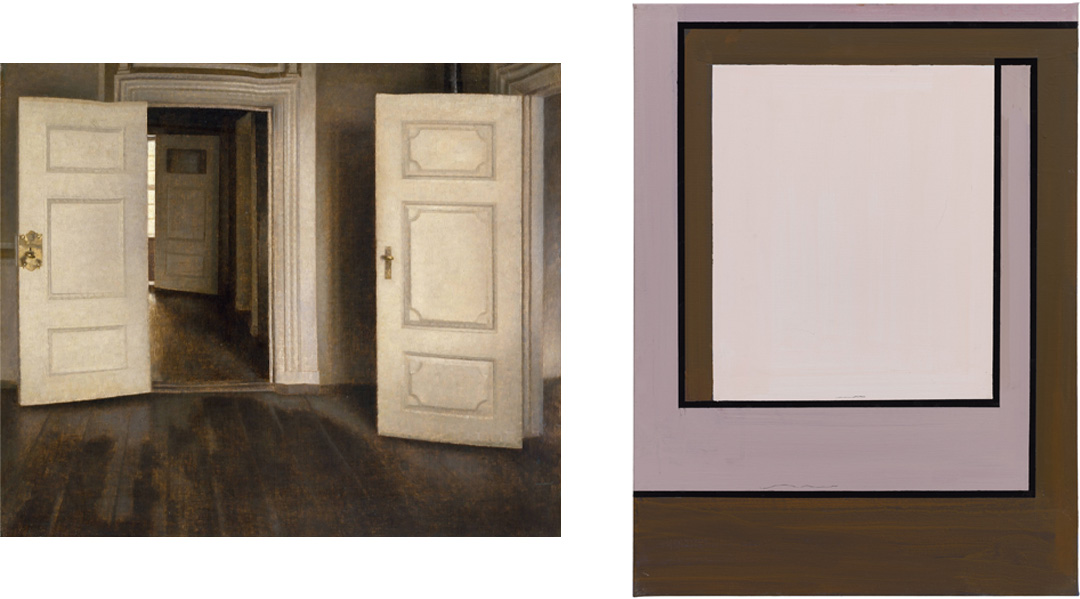
L) Vilhelm Hammershoi, Open Doors, 1905; R)Gary Stephan, Untitled, 2023
내 침실에는 친구가 그린 프라 안젤리코Fra Angelico의 성 베드로 순교자가 있는 수태고지Annunciation with Saint Peter Martyr의 복제화가 걸려 있다. 어느 날 아침, 잠에서 깨어나는 순간, 그 그림의 구성이 게리 스테판의 작품과 놀라울 정도로 닮아 있다는 발견했다. 잠결에 봐서 더 충격이었을지도 모르겠다. 프라 안젤리코의 그림 중앙에는 성모의 잉태를 상징하는 신성한 빛이 묘사되어 있다. 왼쪽에는 천상에서 내려와 이 소식을 전하려는 천사 가브리엘이 서 있고, 오른쪽에는 성모 마리아가 하늘로부터 내려오는 메시지를 몸을 낮추어 받고 있다. 아치 형태들이 빛을 중앙에 두고 이 두 인물을 이어준다. 그림의 내러티브가 추상적으로 완성되고 있다. 스테판의 작품에서도 유사한 공간적 역학이 나타난다. 긴 흰색 직사각형이 중심을 단단히 고정하며, 양옆으로 자리한 산호빛 평면들이 중앙의 빈 공간을 감싸고 있다. 스테판은 모더니스트적 사고 안에서 역사 속 위대한 예술가들이 이루어온 공간적 추상의 전통과 우리를 연결해준다.
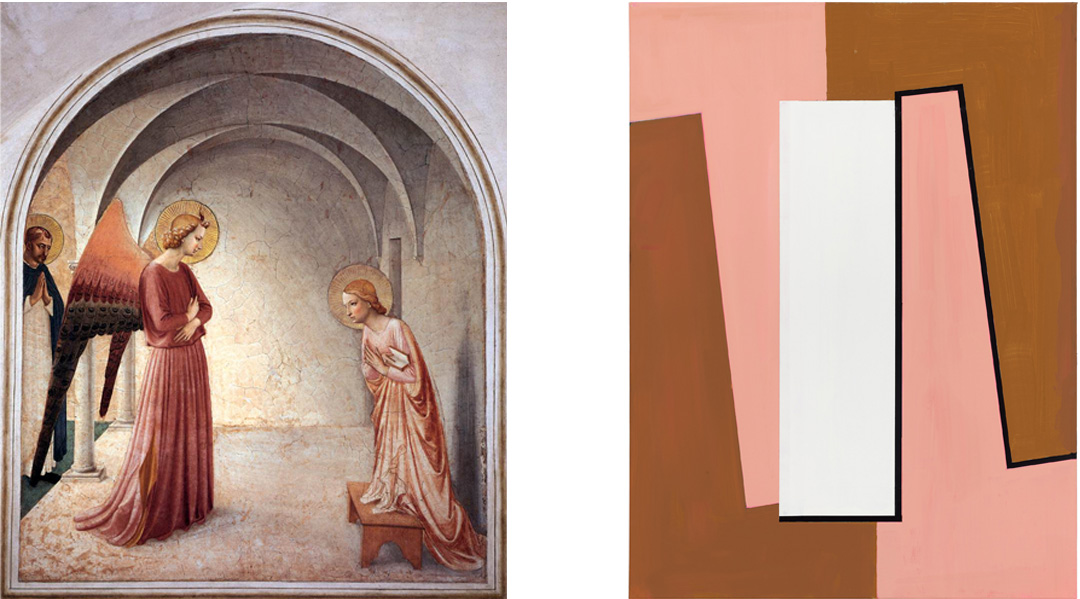
L) Fra Angelico, Annunciation with Saint Peter Martyr, 1440-1442;
R)Gary Stephan, Untitled, 2023
—
전시 제목인 여기 모여 저쪽으로Cohere and Go There는 스테판 특유의 언어유희로, 전시 중 한 작품의 제목이다. 이에 더하여 이 문구는 스테판이 화면의 중심 공간을 지정하고 그 주변을 둘러싼 평면들을 다이내믹하게 전개시키는 과정까지도 암시한다. 스테판의 시도에서 전통적으로 회화에서 고정된 중심으로 여겨져 온 화면의 중심은 불안정해진다. 화면의 중심이 주변의 평면들과 맞물리고 겹치면서 공간 사이의 관계가 흐려지고 우리는 더이상 무엇이 앞에 있고 뒤에 있는지, 무엇이 가깝고 먼지 확신할 수 없다. 이 긴장감은 회화에 대한 전통적인 지각 방식을 흔들며, 특히 화면의 중심 공간—예술사에서 가장 강력한 시각적·서사적 중심으로 여겨진 그 지점—을 다시 보게 한다.
이런 과정에서 우리는 고정된 것과 변동하는 것, 드러나는 것과 숨겨진 것, 담는 것과 여는 것 사이의 긴장을 체험하게 된다. 스테판의 이러한 시도들은 야심차지만, 그 접근 방법은 소박해서, 과장된 제스처 대신 조용하고 서틀한 방식으로 회화의 구조 자체와 대면한다. 여기서 보는 행위는 단순한 관찰이 아닌, 참여하는 행위가 된다. 우리는 지각한 것의 퍼즐을 맞추기 위해 작품과 긴밀히 교감해야 하고, 명확한 해답을 주지 않는 그림 앞에서 인지의 지평을 넓혀야 한다. 두치오의 마에스타Maestà 모퉁이 문처럼, 스테판의 회화는 공간 뿐이 아닌, 시간, 변화, 그리고 끊임없이 진화하는 그의 세계로 들어가는 포털이 된다.
Mimi Park