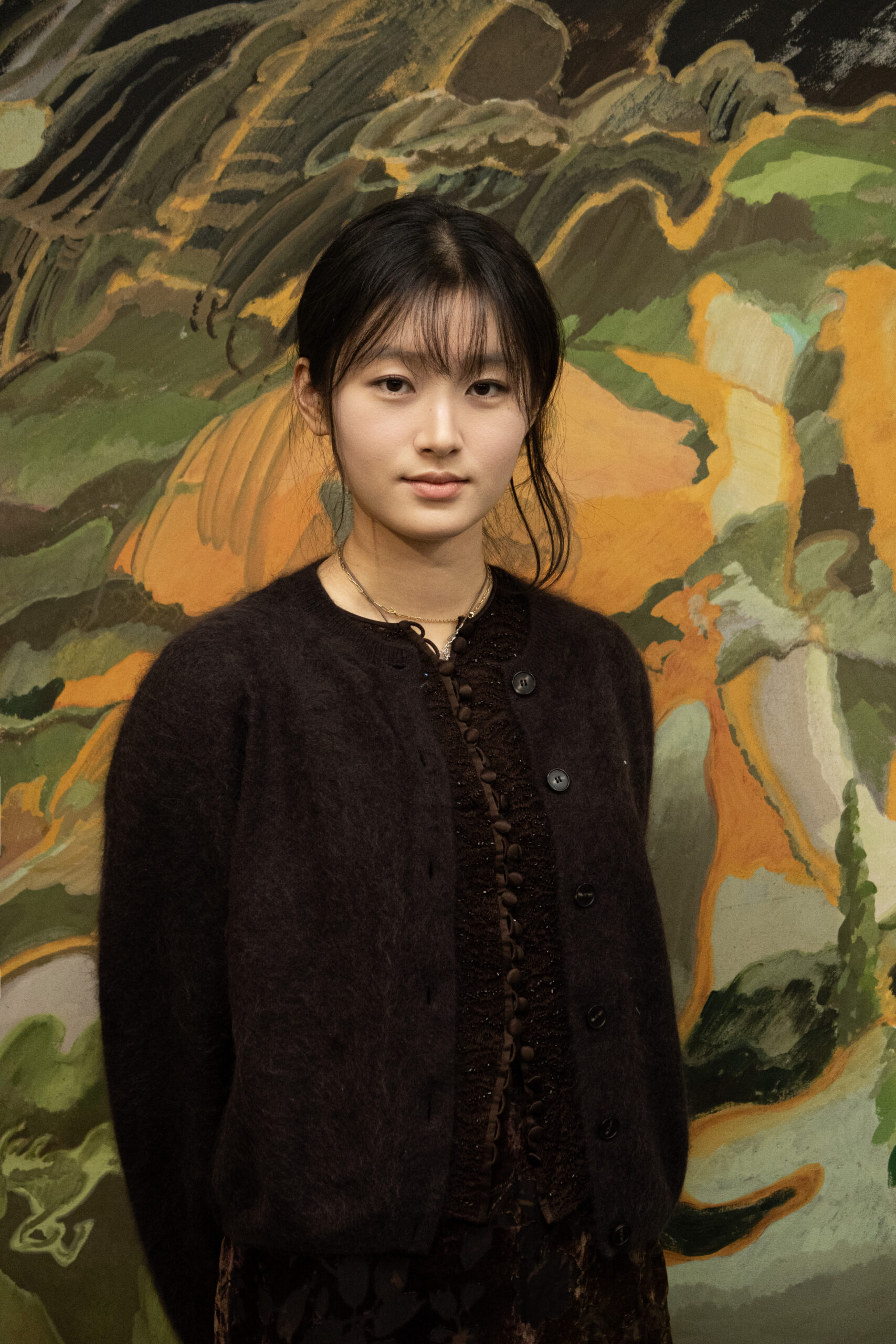
While identity in contemporary art is often foregrounded through personal experience and consumed in political or social terms, Roh steps back from this mode, situating her process of growth within myth—an archetypal narrative shared across human history. This approach may be understood as an effort to reflect on the individual from a humanistic perspective, in a register beyond the reach of political language. In her work, narrative is not conceived as a story with a fixed beginning and end, but as something open, mutable, and continually reformed, much like myth itself. Within this framework, Roh adopts temporal, spatial, and psychological distancing as her fundamental methodology. Born in Korea and trained in design at Parsons School of Design in New York, Roh returned to Seoul and purposefully chose to work in East Asian painting, using its materials to depict Western myths. Rather than remaining within the secure confines of tradition, she revives it by introducing unfamiliar narratives, gradually constructing her own visual language. In this process, painting functions not as a vehicle of visual imagery but as a site of reflection. By refusing to confine herself within socially prescribed political language, and instead making a series of courageous choices, Roh demonstrates a mature sensibility that seeks to expand her relationship with the world and move toward a more universal mode of perception.
노채연의 작업은 동시대 젊은 작가들이 직면하는 정체성의 문제를 사유하는 또 다른 경로를 제시한다는 점에서 주목할 만하다. 오늘날 미술에서 정체성은 종종 개인의 경험을 전면화하며 정치적·사회적 언어로 소비되어 왔지만, 노채연은 이러한 방식에서 한 발 떨어져 자신의 성장 과정을 신화라는 인류 보편의 서사 안에 위치시킨다. 이는 정치적 언어가 닿지 못하는 영역에서 개인을 인문적으로 사유하려는 시도라 할 수 있다. 여기서 노채연의 서사는 시작과 끝이 있는 이야기가 아닌, 신화처럼 반복되고 변형되며 열려 있는 이야기로 바라본다. 이러한 태도 속에서 그녀는 시간적, 공간적, 심리적 ‘거리’ 두기를 그녀만의 방법론으로 삼는다. 한국에서 태어나 뉴욕의 파슨스 스쿨에서 디자인을 공부한 뒤 서울로 돌아온 그녀는 의도적으로 동양화라는 장르를 선택하고, 그 재료로 서양의 신화를 소재로 한 내용을 그린다. 전통이라는 안전한 틀에 머무르기보다, 그 안에서 다시 낯선 신화를 호출하며 자신만의 구성과 색채, 서사 방식을 구축해가는 과정에서 회화는 재현의 양식이 아니라 사유와 실험의 장이 된다.